Khoukha Khoussa, Patrick Lévêque, Larbi Boubchir
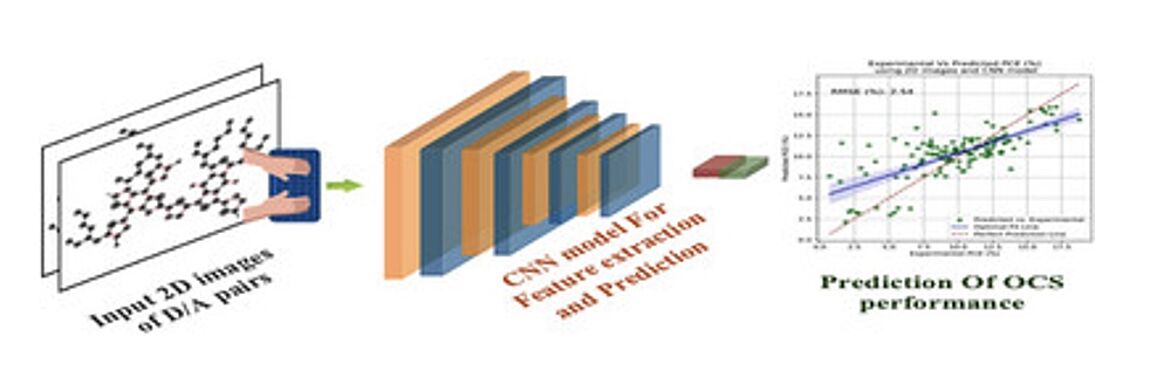
Organic Photovoltaic (OPV) Devices Have Emerged as a Promising Alternative to Conventional Solar Cells due to Their Flexibility, Lightweight Nature, and Potential for Low-cost Production. However, Optimizing OPV Performance Remains a Complex Challenge, Traditionally Requiring Extensive Experimental Trials or Computational Chemistry Approaches Based on Molecular Descriptors. To Accelerate the Development of High-efficiency OPVs, Artificial Intelligence (AI) Has Been Increasingly Utilized, Particularly Machine Learning Models That Rely on Chemical Descriptors. While these Methods Have Shown Success, They Are Often Limited by the Quality and Completeness of the Selected Descriptors, Potentially Overlooking Key Structural and Morphological Information. In this Work, We Propose a Novel Deep Learning Framework Leveraging Convolutional Neural Networks (CNNs) to Predict OPV Performance Directly from 2D Images of Donor and Acceptor Materials. By Employing a Customized Representation of Molecular Structures, Our Approach Captures Spatial and Hierarchical Patterns That Traditional Descriptors Based ML Models May Miss. We Compare Our Model's Predictive Capability to Conventional Machine Learning Techniques and Demonstrate Its Potential for Improving Prediction Accuracy and Generalization without Need to Add the Frontier Molecular Orbitals (FMOs) to Enhance Predictions. Our Findings Highlight the Power of Deep Learning in Accelerating the Discovery of Efficient Organic Photovoltaic Materials, Paving the Way for a Data-driven Approach to Materials Science and Device Optimization